Online Dutch Course: Why Most Waste Your Time (And Money) | SociaTaal

Most online Dutch lessons just moved the classroom to Zoom. Here's why that fails, and what a real online Dutch course should look like if you want to speak.
Aug 4 / Koen Kleinstra
You're paying for an "online" Dutch course. And somehow you're still sitting in a group of 12 people, barely getting a word in.

That's 100% the reason I started SociaTaal. If you want to learn Dutch online and actually get to a point where you can hold a conversation, the format you sign up for matters more than almost anything else.

What happened in 2020

Back in 2020, every language school had to move online, whether they were ready or not. They took their in-person course, opened Zoom, and called it a day.

And honestly, that made sense at the time. It all had to happen in 24 hours.

But it's six years later now, and not much has changed. Same books. Same big groups. Same format. Most online Dutch lessons are still just the in-person lesson with a webcam pointed at it, and online is still treated as the "less good" option, the compromise you settle for instead of a real classroom.

But that's not the real problem.

The real problem: you're paying twice

The real problem is that students are paying twice. Once with money, and once with their time. And nobody talks about the second one.

If your group is too big to actually speak, you're not learning how to speak. You're just learning things you could technically do on your own, in a book or an app, except now you're doing it less efficiently, on a schedule, with a group of strangers who all want a turn too.

That's the part most online Dutch courses never fixed. They digitized the classroom, but they never rethought what the classroom was actually for. Learning a language is not the same as sitting through lessons about a language, and the difference shows up fast once you try to speak.

So we built something different

When we built SociaTaal, we didn't just ask "how do we move classes online." We asked "what does an online Dutch course need to actually work."

That turned into a few non-negotiables:
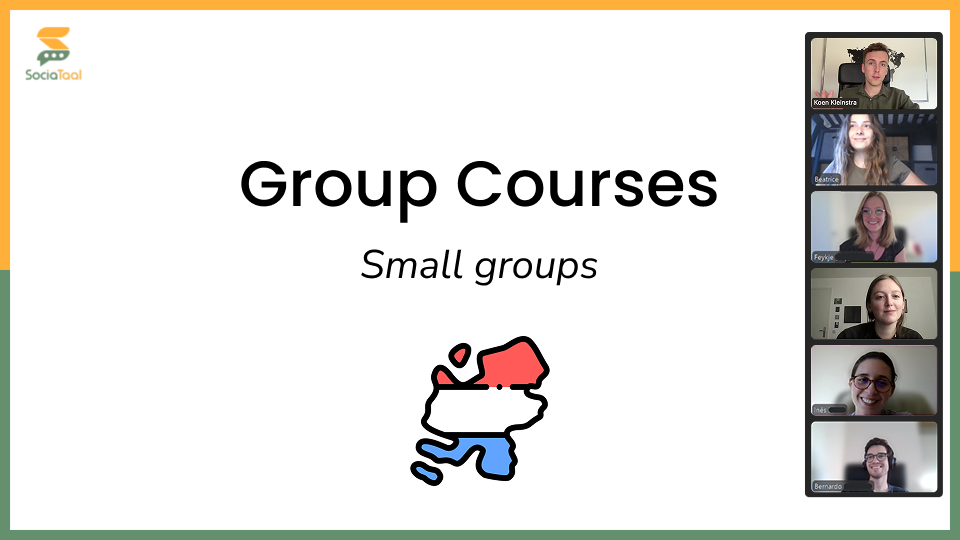
  • Small groups, max 6 students
    Enough people for real conversation, never so many that speaking time gets swallowed.
  • Classes focused on speaking only
    No grammar lectures during class. Class is for using the language out loud.
  • Homework and exercises before class
    So class time is 100% conversation, not explanation. The explanation part serves as preparation for speaking. We provide structured materials for this.
No 12-person calls where you're lucky to speak for a hand full of minutes. No class time spent on grammar you could've read at home. Just structured, small-group conversation practice with a real teacher, every session.

Why we obsess over this specific split

Here's the part most students never think about, but should: roughly 80% of what you pay for an online Dutch course is the teacher's time. Not the book, not the platform, not the login. The teacher.
The question worth asking: 
What can that teacher actually do that you can't do alone? Grammar and vocabulary, you can learn by yourself. Real-time speaking practice and feedback, you can't.
Grammar rules, vocabulary lists, conjugation tables: you can learn all of that by yourself, with a book, an app, or a good set of exercises. It takes discipline, but it doesn't require another person in the room. A teacher isn't necessary for that part.

Speaking is different. You cannot practice real-time conversation by yourself. You can't correct your own pronunciation while you're mid-sentence. You can't simulate someone responding to you, adjusting to what you say, pushing back, asking a follow-up question. That only happens with another person, ideally a teacher who can catch your mistakes as they happen and nudge you in the right direction on the spot.
What you're learning Can you do it alone? Best used for
Grammar rules & conjugation Yes, with discipline Homework, before class
New vocabulary Yes, with discipline Homework, before class
Real-time speaking & pronunciation No, needs a teacher Class time, with feedback
Reacting to a real conversation No, needs a teacher Class time, with feedback

Which means the one thing a teacher is genuinely irreplaceable for is exactly the thing most courses spend the least time on in class. Instead, students still watch a teacher explain grammar on a shared screen, the same explanation that could've just been a short video or a page of notes done at home. That's expensive time spent on something that didn't need a teacher in the first place.

So we flipped it. In our online Dutch language course, homework and preparation happen before class, on your own schedule, covering the vocabulary and grammar you're about to use. Class time is reserved entirely for speaking: using what you prepared, in real conversations, with real feedback, from the person you're actually paying for.

The result is that every minute of that 80% goes toward the one skill you can't build on your own.

The result

Students speak faster, progress quicker, and waste less time getting there. Because the format is built around the one thing that actually moves the needle: speaking Dutch out loud, regularly, with feedback.

An online Dutch course can absolutely be better than an in-person one. You get the flexibility of learning from anywhere, without losing the structure and speaking practice that actually built your progress in the first place. But doing it right takes real effort, and most schools just don't bother.

The bottom line

If you've tried an online Dutch language course before and it felt like a slower, lonelier version of school, that's not because online doesn't work. It's because most schools never redesigned the format for it. A big group on Zoom is still a big group, it just has worse internet.

Good online Dutch lessons give you the flexibility to learn Dutch online from anywhere, plus the speaking time and teacher feedback you'd expect from the best in-person classroom. You shouldn't have to pick one or the other.
Online Dutch Group Course SociaTaal

Ready to take your Dutch seriously?

At SociaTaal we offer structured Dutch courses designed for motivated adults. No fluff, just real progress and focus on speaking Dutch.

FAQ: Common Mistakes When Learning Dutch on Your Own

Is an online Dutch course actually as effective as an in-person one?
It can be, but only if it's built for online, not just moved there. Small groups and a speaking-first format matter far more than whether the class happens in a room or on a screen.
What's a good group size for an online Dutch course?
Anything much bigger than 6 to 8 people makes it hard for everyone to actually speak during class. If speaking practice is the goal, group size is the first thing to check before you sign up.
Why do homework before class instead of during it?
Because grammar and vocabulary can be learned alone, at your own pace. Speaking Dutch out loud with feedback can't. Doing the prep work beforehand means class time goes entirely toward the part you can't practice by yourself.
Can you really learn Dutch online without ever sitting in a classroom?
Yes. What matters is whether your online Dutch lessons give you regular speaking time with a teacher and a small enough group to use it. A physical room adds nothing on its own.